Process - tracking records through space and time
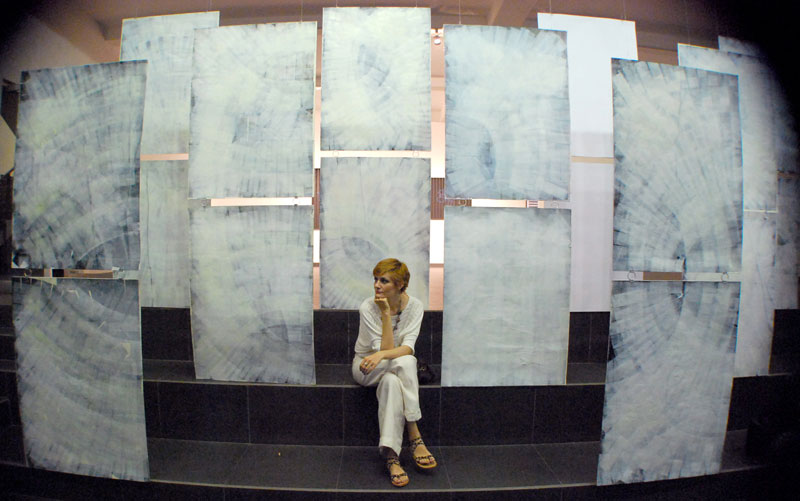
The artistic project Process - tracking records through space and time is the result of many years of research related to the process of artistic creation, where the work of art is the origin, not the goal. Technically, it relies on an experimental approach to classic graphic media and print, and thematically on reflection. The subject and the technique, which are based on the principle of duplicating the image, i.e. the matrix, interestingly supported each other by creating a self-reflexive mechanism that examines and highlights the limits and possibilities of the media: print and paper.
Started in 2001 and developed in several stages, the project is subject to the idea of summarizing all previous and future stages in one work with the aim of following the successive changes and transformations that take place in the creative process, material and spatial organization of work. The key to summarization is the annulment of the material and independent existence of individual phases. Paper, whose materiality I examine in the creative process, becomes the main mediator in the technological solution to this problem. In the field of graphics, paper is the carrier of the work, which has the function of displaying the reflection (print of the matrix) like a mirror, but, unlike it, also retains it. This retention is the formal shaping of the work by depositing impressions, pressures and traces. I try to give the paper somewhat of a mirror quality that does not retain the reflection, by not stopping the process at the moment of aesthetic fulfillment, but continuing the deposition on the same paper. The process becomes a continuous flow, in constant change, and the form of the work is a set of all micro and macro changes in material, space and time without the intention of final shaping. In other words, the work does not have a final visual goal, nor an end, it is a process whose appearance is reflected in the moments of showing the current phase.
Conceived as a multi-decade project, the project is conceptually divided into phases that are separated, but also connected by color and method. The idea of four phases, each characterized by a certain color (black, white, red, gold), was inspired by the phases of the alchemical "recipe" of turning raw material into precious or lead into gold.
Countless passes through the press gently and slowly wear away the fragile substance of the paper, while, at the same time, thin layers of paint solidify it, thus changing its materiality. Thus, industrial paper made of non-precious material, by crushing it with a press and applying countless extremely thin and transparent layers of graphic paint, becomes a fine, velvety, slightly worn material. Artistic documentation follows and records all interventions in the work and spatial settings, which, given that the work is exhibited as a spatial setting, always gives it a new form. In the form of video works and artistic objects (portfolios with photographs), it bears witness to the successive stages of the formal elaboration of the work and presents to the observer the entire development, flow and process.
Ivana Stojaković
the author